
 |
 |
 |
 |
 |
 |
Earlier American Music Timeline
Part One: 1620 - 1818
Compiled by Roger Lee Hall, musicologist
Part One covers music composed and published in America between the time of the Pilgrims and Puritans in the 17th century and the first performance of a large scale oratorio by the Handel & Haydn Society.
Part Two lists music composed and performed in America between 1820 and 1920.
It is a selective listing and makes no claim to be comprehensive and list every musical event. There are too many to include them all.
The entries are intended to highlight key historical events and music composed during these centuries.
There are also links to American Music Preservation pages.Your comments or questions are welcome about this survey.
Send them to:
American Music History Timeline
Click on these links to read the entries for...
Please help support this resource...
Order your music items from the
17th century
1620 The Pilgrims (or Separatists) land in Provincetown and establish a colony in Plymouth, Massachusetts. The psam book they sing from is The Book of Psalms by Henry Ainsworth, 1612. One of the best known psalm tunes sung is Old 100th sung to Psalm 100 ("Shout to Jehovah all the earth).
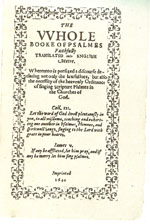
1640 The first edition of The Whole Booke of Psalmes Faitfully TRANSLATED into ENGLISH Metre (also known as The Bay Psalm Book) was printed in Cambridge, Massachusetts without music. This was the third publication in British Colonial America. From the Preface by John Cotton in Old English:
"That soe wee may sing in Sion the Lords songs of prayse according to his owne will...and bid us enter unto our masters ioye to sing eternall Halleluiahss."
[translation: That so we may sing in Zion the Lord's songs of praise according to his own will...and bid us enter unto our master's joy to sing eternal Hallelujahs]One of the best known psalms is: "Psalm 23."
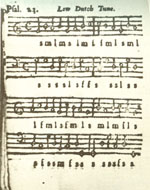
1698 Ninth edition of The Bay Psalm Book (original title: The Psalms, Hymns, and Spiritual Songs of the Old & New Testament: Faithfully Translated into English Meetre) was the first one to contain music (13 tunes in two voice parts). The tunes included: "Low Dutch Tune" [shown at right], and "Psalm 100".
18th century
1721 First music printed with barred notes in a collection by Rev. Thomas Walter from Roxbury, Massachusetts and titled: The Grounds and Rules of Musick Explained, or An Introduction to the Art of Singing By Note.
1726 What is believed to be the earliest American tune was composed by Rev. John Tufts from Dedham, Massachusetts and published in the fifth edition of his tune collection: An Introduction to the Singing of Psalm-Tunes. There were 37 tunes in three voice parts in this collection. The tune attributed to Rev. Tufts was titled: "100 Psalm Tune New."
1730 First collection of Pennsylvania German hymns, printed by Benjamin Franklin in Philadelphia and titled: Gottliche Liebes Und Lobes Gethoene. This was a collection of hymns by Conrad Beissel from the Ephrata Cloister (also known as Seventh Day Baptists).
1737 First organ built in British North America by Johann G. Klemm (or Clemm) of Phildephia, for Trinity Church in New York City.
1747 First choral music collection from the press of the Ephrata Cloister, a Protestant monastic order in Pennsylvania: Paradisches Wunder-Spiel. The words were printted with space left for the music to be entered by hand.
1759 First song written by a native born American, "My Days Have Been So Wondrous Free" This song was written by Francis Hopkinson who would later serve as a delegate in Philadelphia and was a signer of the Declaration of Independence. He was also a designer of the first American flag.
1761 First music collection compiled by an American musician: Urania. A Choice Collection of Psalm-Tunes, Anthems and Hymns. This collection compiled by Rev. James Lyon also contained a few of his own tunes.
1762 First musical society, titled The St. Cecilia Society, founded in Charleston, South Carolina. This society's history remains shrouded in mystery but is known to be a sponsoring group for concerts and not a performing organization.
Also this year the first documented singing meetings in a diary of Elijah Dunbar were held in Stoughton, Massachusetts and led to the later formation of the Stoughton Musical Society [see 1786]
1768 First propaganda song text: "The Liberty Song" , words by John Dickinson, and set to an English tune by William Boyce, "Heart of Oak."
1770 First collection of music by a native born composer, The New-England Psalm-Singer by William Billings (1746-1800), who was primarily a tanner in Boston, but also a singing teacher and composer.
1771 First song to appear in a periodical: "The Hill Tops: A Hunting Song." Published in Royal American Magazine, Volume I, April 1771, Boston, Massachusetts.
1774 Billings taught a singing school in Stoughton, Massachusetts and it is the only one at that time with all the students listed. One of the students was Jacob French, who later became a composer.
1775 First piano-forte manufactured by John Behrent of Philadelphia.
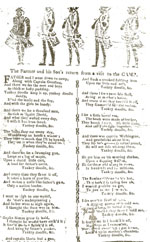
1776 "Father and I Went Down to Camp" -- probably the earliest American words written to the "Yankee Doodle" tune, printed as a broadside, and attributed to Edward Bangs, a student at Harvard College. It has been claimed that Dr. Richard Schukburgh (or Schakburg) wrote the first American words to "Yankee Doodle" near Albany, New York in 1755, but there is no proof of that claim. The composer of the "Yankee Doodle" tune is unknown but it is beleived to have been written in America in the 1750s or 1760s.
1778 First patriotic war song by a native American: Chester, words & music by William Billings. The tune was first written by Billings in 1770 and five stanzas were written in 1778. A new text (not by Billings) was added in 1786 and was sung for many years by the Old Stoughton Musical Society. It has been recorded.
1786 The Stoughton Musical Society was founded when 25 male singers were listed in a journal. Contrary to popular belief, neither Supply Belcher nor William Billings had any direct connection to forming this musical society. This is now the oldest choral society in the United States.
1787 "The Grand Constitution", a ballad written about the U.S. Constitution is set to the English tune, "Heart of Oak." This ballad was performed in 1987 for the bicentennial of the U.S. Constitution and also the Stoughton Musical Society's Constitution written in October of 1787, just two weeks after the U.S. Constitution. It is now the oldest constitution of any musical organization in the United States.
1788 First secular music printed by a native born composer: Seven Songs for the Harpsichord or Forte Piano, by Francis Hopkinson. Actually there are eight songs and they are dedicated to George Washington.
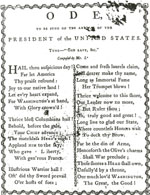
1789 Songs written in tribute to George Washington's Inauguration as First US President, including an "Ode to the President of the United States (words by Samuel Low) and set to the English tune, "God Save the King."
1790 About this year the first known singing contest was held in the United States between the choir of the First Parish Church in Dorchester and the male singers of the Stoughton Musical Society. The Stoughton group won the contest after they sang Handel's "Hallelujah Chorus" from memory and without any instrumental accompaniment -- an impressive performance for its time. This famous chorus had been published in the U.S. for the first time in 1786.
1791 First orchestral score published in America was the song, "The Death Song of an Indian Chief," composed by Hans Gram, who had emigrated from Denmark. This song was published in The Massachusetts Magazine, Vol. II (March 1791).
1794 Several important tune collections were published. One was The Continental Harmony by William Billings. Another one was The Harmony of Maine by Supply Belcher of Farmington, Maine [shown at right]. Belcher was originally from Stoughton, Massachusetts.
1797 "The Battle of Trenton" by James Hewitt, dedicated to George Washington and includes "Washington's March" and "Yankee Doodle."
1798 First use of the popular English tavern tune, " Anacreon in Heaven" in a song dedicated to President John Adams: "Adams and Liberty."
Also "Hail! Columbia" was written by Joseph Hopkinson (son of Francis Hopkinson) to the tune of "The President's March."
The United States Marine Band was organized in 1798.
1799 Memorial songs composed in memory of George Washington, such as Peter A. con Hagen's "Funeral Dirge on the Death of General Washington."
19th Century
1805 One of the first collections with American folk hymns titled, The Christian Harmony, or Songster's Companion, by Jeremiah Ingalls, published in Exeter, New Hampshire. Ingalls later moved to Newbury, Vermont where he wrote more sacred music. His music has remained popular with various choruses, like the Old Stoughton Musical Society, whose favorite Ingalls tune has been NEW JERUSALEM.
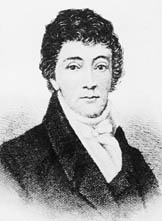
1814 "The Star-Spangled Banner" (original title: "Defence of Fort McHenry") was written by Francis Scott Key [above portrait] and set to the tune of "Anacreon in Heaven." The original title of the poem by Key was "The Defense of Fort McHenry" and it was first published in several Baltimore newspapers a short time after it was written on September 16, 1814.
1815 The Handel & Haydn Society was founded and gave its first concert on Christmas Day in Boston. It is now the oldest continuous performing arts organization in the U.S.
1817 "There's Nothing True But Heaven" - words by Sir Thomas More and music by Oliver Shaw is one of the first popular songs.
1818 The first complete performance of G.F. Handel's oratorio, Messiah (1742), as it was published at that time on 25 December by The Handel & Haydn Society in Boston. It continues on today with H & H in annual performances, usually held in December.
SOURCES:
Harry Dichter & Elliott Shapiro. Handbook of Early American Sheet Music, 1768-1889. R.R. Bowker Co., reprint by Dover Publications, 1969 and 1977. 287 pages.
W. Thomas Marrocco and Harold Gleason. Music in America: An Anthology from the Landing of the Pilgrims to the Close of the Civil War, 1620-1865. W.W. Norton & Co. Inc., 1964. 371 pages.
American Music Recordings Archive (AMRA)
To continue to Part Two of the American Music Timeline (1822-1920) --
click here
Additional Links
American Music Recordings Collection (AMRC)
American Song History Survey (ASHS)
Center for American Music Preservation (CAMP)
Essential American Recordings Survey [EARS]
Preserving American Music Series (PAMS)
© 2006-2025 PineTree Productions. All Rights Reserved for original material on this site.
Contact: pinetreepro@aol.com