
 |
 |
 |
 |
 |
 |

 |
 |
New England Song Series
ONE HORSE OPEN SLEIGH:
The Story of "Jingle Bells"
.jpg)
One of the most popular songs heard during the Christmas season began
not for that holiday but as a song with this title,"One Horse Open Sleigh"
(original sheet music cover shown above, first published in 1857
by Oliver Ditson in Boston). It was apparently written as a comical song
and used in minstrel shows at that time.There has been a long-standing dispute about what city the song
was written.According to the book, Boston Curioisities (page 173),
this information is provided:
"Jingle Bells" was written by Medford [Massachusetts] resident James Pierpont in 1850, inspired by the annual one-horse open-sleigh races on Salem and Pleasant Streets between Medford Square and Malden Square. Pierpont penned the racy little ditty in Simpson's Tavern, a boardinghouse that had only one piano in town.
This is interesting about how the song might have been written
but the date of origin is not certain
since the two authors (Bruce Gellerman and Erik Sherman)
don't provide any source for their information.
Two years later after it was first published, the title was changed to:
"Jingle Bells, or The One Horse Open Sleigh"
James Lord Pierpont was born in Medford, Massachusetts in 1822 and died
in Winter Haven, Florida in 1893. He had a rather unusual life, coming from
a strict New England Unitarian family who were against slavery. He moved
to the South and was an organist in a church in Savannah, Georgia.Against his family's wishes, he supported the Confederate cause,
writing several songs in support, including "Strike for the South"
and "We Conquer or Die."
It has been reported, though not proven, that he wrote his popular winter
song for his father's Sunday School class for Thanksgiving and it proved so
popular that it was sung again at Christmas time. One of Pierpont's friends
called the song -- "a merry little jingle."These are the original lyrics and spellings for the first two of the four verses:
1. Dashing thro' the snow,
In a one horse open sleigh,
O'er the hills we go,
Laughing all the way;
Bells on bob tail ring, Making spirits bright,
Oh what sport to ride and sing
A sleighing song tonight.Chorus:
Jingle bells, Jingle bells,
Jingle all the way;
Oh! what joy it is to ride
In a one horse open sleigh. [repeat four lines]2. A day or two ago
I thought I take a ride
And soon Miss Fannie Bright
Was seated by my side,
The horse was lean and lank
Misfortune seem'd his lot
He got into a drifted bank
And we, we got up sot.Chorus:
Jingle bells, Jingle bells,
Jingle all the way;
Oh! what joy it is to ride
In a one horse open sleigh. [repeat all four lines]After he wrote the song Pierpont paid little attention to it until the Salem
Evening News printed a story about it in 1864. Then he accepted credit for
writing "Jingle Bells." There has been speculation that Pierpont borrowed
lines from a Stephen Foster minstrel song but that has remained unproven.James Pierpont's uncle was the famous wealthy New York financier,
John Pierpont Morgan.
Though he died in Florida, James Pierpont was buried in
Savannah, Georgia in Laurel Grove Cemetery.There was a marker placed in
Troup Square in Savannah to honor him --
Did Pierpont write "Jingle Bells" in Medford, Massachusetts
or Savannah, Georgia? Both places make claim to the song's origin.Yet it seems likely that he wrote the song in Medford where snow was
commonplace rather than in the warmer climate of Savannah.
This marker is located at 19 High Street in Medford:
"Jingle Bells" was not very popular when it was first published in 1857.
It took many years to become one of the most popular songs at
Christmastime.Among the earliest recorded versions of the song were on music boxes
and other mechanical music devices.When did it start to become popular as a Christmas song?
That happened first with the spread of phonograph records and later on
radio, which allowed the song to be heard by a nationwide audience.The following list of recordings comes from an entry at Wikipedia:
"Jingle Bells" was first recorded by the Edison Male Quartette in 1898 on an Edison cylinder.
In 1902, the Hayden Quartet recorded the song.
In 1935, Benny Goodman and His Orchestra reached No. 18 on the charts with their recording of "Jingle Bells."
In 1941, Glenn Miller and His Orchestra with Tex Beneke, Marion Hutton, Ernie Caceres and the Modernaires on vocals had a No. 5 hit with "Jingle Bells" on RCA Victor.
In 1943, Bing Crosby and the Andrews Sisters recorded "Jingle Bells" on Decca which reached No. 19 on the charts and sold over a million copies.
In 1951, Les Paul had a No. 10 hit with a multi-tracked version on guitar.
In 1955, Don Charles, from Copenhagen, Denmark, recorded a novelty version with dogs barking to the melody of "Jingle Bells," which sold a million copies in 1955.
Among all these recordings, it was Bing Crosby with The Andrews Sisters
who made the song the most popular.Their 1943 recording is the one most often heard today
during the Christmas season.
One hundred fifty years after it was published as "Jingle Bells,"
there are millions of listeners who know and love this song,
even though it makes no
mention of Christmas in its lyrics.Yet it does evoke what many people think of as a nostalgic Christmas from
the past --a winter scene riding through the snow and singing...
Jingle bells, Jingle bells,
Jingle all the way.
Oh what joy it is to ride
In a one horse open sleigh!Article by Roger Hall, American Music Preservationist
Hear "Jingle Bells" played on a Regina music box -- click here
Information for this article was gathered from these sources:



-
The Book of World-Famous Music: Classical, Popular, and Folk (Fifth Edition, 2000) -
by James J. Fuld.
-
Christmas Songs Made in America: Favorite Holiday Melodies
and the Stories of Their Origin by Albert J. Menendez and Shirley C. Menendez (1999)
Celebrate with Christmas Music!
You can order individual music titles from this album
CHRISTMAS MUSIC IN AMERICA (AMRC CD 0034)
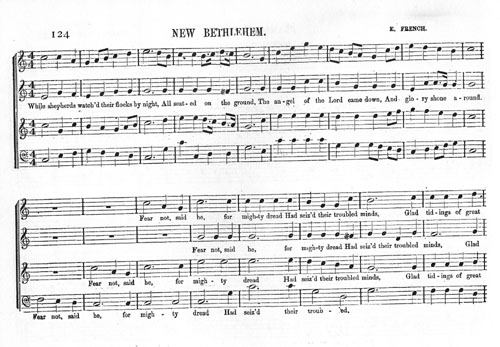
"NEW BETHLEHEM" - Christmas Music From New England (AMRC 0010)

Other titles in the New England Song Series
"GOIN' HOME" - From Bohemia to Boston
"Tis the gift to simple" -
Elder Joseph Brackett's Shaker dance song
"Father and I Went Down to Camp" -
The Boston Yankee Doodle Ballad

© 2010-2025 PineTree Productions.
All original written material is protected on this website. Contact: pinetreepro@aol.com: