
 |
 |
 |
 |
 |
 |


New England Song Series No. 3:
j
"BATTLE HYMN OF THE REPUBLIC"
Origins of a Civil War song
on the 150th anniversary
of its first printing
- The Words: Battle Hymn of the Republic as told by Julia Ward Howe
- The Music: Methodist hymn and the John Brown song
- The Hit Record: Million-seller and Grammy Award winner
- The Lecture: Civil War texts and tunes
- Related Links
The following information was
researched and written by
Roger L. Hall, music preservationist
Center for American Music Preservation
The Words
First verse written by Julia Ward Howe:
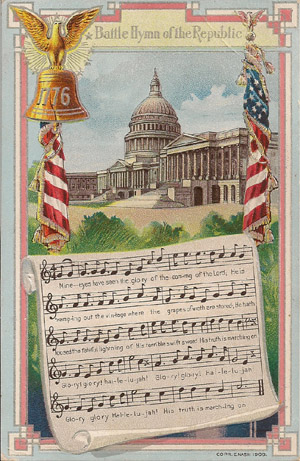
Mine eyes have seen the glory
of the coming of the Lord:
He is trampling out the vintage
where the grapes of wrath are stored;
He hath loosed the fateful lightning
of His terrible swift sword:
His truth is marching on.
"The poem, which was soon published in the Atlantic Monthly, was somewhat praised on its appearance, but the vicissitudes of the war so engrossed public attention that small heed was taken of literary matters. I soon was content to know, that the poem soon found its way to the camps, as I heard from time to time of its being sung in chorus by the soldiers."
--from Reminiscences 1819-1899 by Julia Ward Howe, Boston, Massachusetts, 1899.
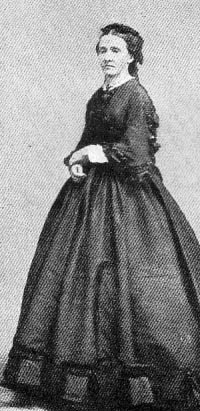
Portrait of Julia Ward Howe, about 1865
A more complete account of how she wrote the words for the hymn is reprinted
as a document on the multimedia collection,
"Glory, Hallelujah" - Songs and Hymns of the Civil War EraThe first draft of Julia Ward Howe's poem was written in November 18, 1861.
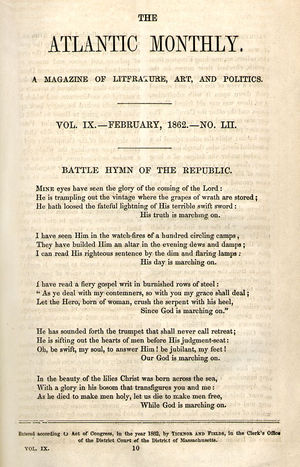
According to James J. Fuld the first printed copy of her poem was in the
New York Tribune on January 14, 1862 with the text possibly sent to themfor promotional use by the Atlantic Monthly. The following month her poem was
published in the Atlantic Monthly magazine, which had a wider circulation.
Notice that it was first printed without the familiar "Glory, Hallelujah" chorus,
as shown here:
In the book about her mother's noble poem, her daughter wrote the following
about it in these excerpts:""In her Recollections of the Anti-Slavery Struggle she ascribes its composition to two causes -- the religion of humanity and the passion of patriotism. My mother had a long cherished love for her country, but it burned more intensely when the war came, bursting into sudden flame after that memorable day with the soldiers."
"It was published in the Atlantic Monthly for February, 1862. The verses were printed on the first page, being thus given the place of honor. According to custom of that day, no name was signed to them. James T. Fields was then editor of the magazine. My mother consulted him with regard to a name for the poem. The price paid for it was five dollars. But the true price of it was a very different thing, not to be computed in terms of money. It brought its author fame throughout the civilized world, in addition to the love and honor of her countrymen."
-- The Story of the Battle Hymn of the Republic, by Florence Howe Hall, Harper & Brothers, 1916.
The Music
"Battle Hymn of the Republic" has been sung countless times
since it was first published in 1862.
The person who is usually credited for composing the tune is William Steffe.
But there is no written evidence to prove that he actually wrote the Glory,
Hallelujah tune. It is more likely that the tune came from a camp meeting
spiritual by an unknown composer. According to John Staufferand Benjamin Soskis in their book,
The Battle Hymn of the Republic: A Biography of the Song
That Marches On (2013), there is a version of the original textas early as an 1807 hymnal with these opening words:
O brothers will you meet me,
O brothers will you meet me,
O brothers will you meet me
on Canaan's happy shore?Another later version from the 1850s has slightly different words:
Say brothers will you meet us (repeated twice more)
on Canaan's happy shore?During the 20th century, the Battle Hymn was sung by everyone from the
Columbia Mixed Quartet in 1912to Elvis Presley in the 1970s in Mickey Newbury's "An American Trilogy,"
and it continues on today. This stirring patriotic hymn has been sung for many
solemn occasions, like the worship service at the National Cathedral in
Washington, DC after the terrorist attacks of 9/11/2001. It has also been sung
at sporting events and show biz events -- on radio, television, and records.The tune known as "Glory, Hallelujah" was used for the song,
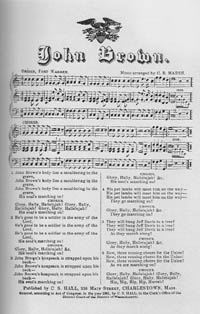
"John Brown" (also known as -"John Brown's Body")
first published as a broadside by C.S. Hall
in Charleston, Massachusetts in 1861 [shown below].
The "Real" John Brown
It has often been credited incorrectly.
Actually, this song was written in jest about
Sgt. John Brown at Fort Warren in Massachusetts
and not the fiery abolitionist, John Brown,
who was hung for his raid on Harpers Ferry in 1859.
The John Brown song was the one that Julia Ward Howe heard
Union soldiers singing and she used that tune
for her war song, "Battle Hymn of the Republic."
"Glory, Hallelujah" Chorus
The same chorus was used for "John Brown" and "Battle Hymn of the Republic."
This chorus "Glory, Hallelujah" must have been well knownsince it was mentioned on the cover of the first printing.
Notice that the title does not have "The" in the title.
The original sheet music cover is shown here:
BATTLE HYMN OF THE REPUBLIC
Adapted to the favorite Melody "Glory, Hallelujah"
written by Mrs. Dr. S. G. [Julia Ward] Howe
for the ATLANTIC MONTHLY
Boston: Published by Oliver Ditson & Co.,
277 Washington St., 1862
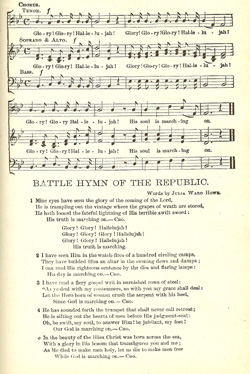
What most writers have missed about this chorus is an important word was
included in the original sheet music printing.In the second line of the Chorus
there is an additional "Glory" making it sound even more stirring:Glory! Glory! Hallelujah!
Glory! Glory! Glory! Hallelujah!
Glory! Glory! Hallelujah!
His truth is marching on.
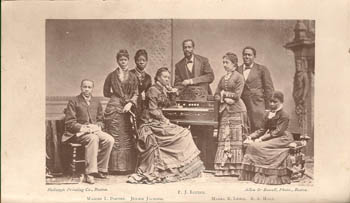
Read about the amazing performance of "Battle Hymn of the Republic" at the
World's Peace Jubilee in Boston in 1872 by the Afro-American group known as
The Jubilee Singers at John Brown Song
Music in Old Boston
One of the first modern day performances of the original "John Brown"
together with "Battle Hymn of the Republic,"
was performed by the Old Stoughton Musical Society Chorus
in Boston for the 350th anniversary celebration of the city in 1980.
Listen to a performance of the versions of
"John Brown" and "Battle Hymn of the Republic"
from the music book
FATHER KEMP'S OLD FOLKS CONCERT TUNES
performed by The Old Stoughton Musical Society Chorus,
conducted by Roger Hall -- click here
Read more about the Jubilee 350 concert at
The Hit Record
(1959)
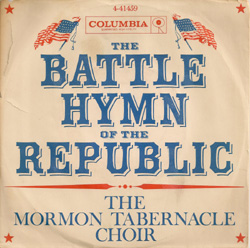
The Mormon Tabernacle Choir, one of America's most popular choruses, has
made numerous recordings of Julia Ward Howe's Civil War hymn,
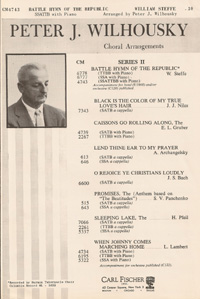
especially the 1944 arrangement by Peter J. Wilhousky,
which has become the preferred one for choruses everywhere.
It should be mentioned that in the 1944 arrangement,
the last verse ends with the original words by Julia Ward Howe:As He died to make men holy, Let us DIE to make men free.
This was changed in a Mormon Tabernacle Choir recording to:
As He died to make holy, Let us LIVE to make men free.Because it was such a hit, the change was adopted by other performers over
the years. The lyrics to "Battle Hymn" were printed on the back of
the 45 RPM record sleeve, released by Columbia Records in 1959, and this isthe last verse:
In the beauty of the lilies Christ was born across the sea,
With a glory in His bosom that transfigures you and me,
As He died to make men holy, Let us LIVE to make men free,
While God is marching on!
According to Joel Whitburn in his authoritative
The Billboard Book of Top 40 Hits, this Mormon Tabernacle record was on the
Billboard charts for 11 weeks and reached as high as No. 13.At the 2nd annual Grammy Awards held on November 29, 1959,
The Mormon Tabernacle Choir, directed by Richard Condie,
received a Grammy Award for Best Performance By a Vocal Group or Chorus.The Mormon Tabernacle Choir recording was a shortened version of
Julia Ward Howe's Civil War song and was suggested to Columbia Records by
the popular and influential Cleveland disc jockey, Bill Randle, so the song would
fit easily on a 45 RPM record. Randle was the one who had introduced Elvis
Presley on national television in January of 1956.
The Lecture
Would you like to schedule a lecture for your organization about the origins of the texts and tunes for "John Brown's Body" and "Battle Hymn of the Republic" with recorded music examples of both tunes and sheet music on display?
For more details about this lecture, click this link:
Related Links
"Glory, Hallelujah!" - Songs and Hymns of the Civil War Era
"John Brown (John Brown's Body)"
"Lincoln and Liberty" - Music From Abraham Lincoln's Era
Singing Stoughton - one of America's oldest music traditions

Please help support the mission of the
Center for American Music Preservation (CAMP)
Order from the

© 2012/ Updated, 2024. PineTree Productions.
All Rights Reserved for original material on this site. Contact: pinetreepro@gmail.com