
 |
 |
 |
 |
 |
 |

 |
 |
Shaker Tunes
and
Non-Shaker Tunes
- "How can I keep from singing" - Is it a Shaker hymn?
- "Happiness" and "How Happy Are They"
- "Lord of the Dance" and "Simple Gifts"
- "Run, Shaker Life" and "Come Life, Shaker Life"
- "The Spiritual Sailor" and "Voyage to Canaan"
- "Welcome, welcome every guest" and "Ode to Contentment"
Some of the non-Shaker tunes sung by the early Shakers include:
"The Black Joke"
"Nancy Dawson"
"Bobbing Joe (or Bobbin Joan)"
"Hie thee Jenny home again"
"The Rose Tree"
For more information, see this source about Shaker tunes:
"Introduction to Zion" - A Shaker Music Guide
 sm.jpg)
A Message to Web Readers:
Should you use any of the information on this page on your web site, in a research paper, or any publication or recording, please give proper credit to the author of these tune comparisons, Roger Lee Hall, who is an ethnomusicologist and Director of the Center for American Music Preservation (CAMP)
Thank you.

"How can I keep from singing" -
Is it a Shaker hymn?
The first verse of the hymn:
My life flows on in endless song;
Above Earth's lamentation,
I catch the sweet, tho' far off hymn
That hails a new creation;
Through all the tumult and strife,
I hear the music ringing;
It finds an echo in my soul -
How can I keep from singing?
There has been a lot of confusion about this hymn.In 1956, an additional verse was written by Doris Plenn and it was published by Pete Seeger in Sing Out! magazine (Vol. 7 No. 1, 1957). Because she had learned it from her grandmother, who said it came from the Quaker tradition, Pete Seeger identified it that way. But it is not a Quaker hymn.
Then nearly 40 years later, on the Platinum selling CD, Shepherd Moons, this hymn was sensitively sung by Enya in an ethereal arrangement by her and Nicky Ryan.
But unfortunately "How Can I Keep From Singing" was incorrectly identified as being a "Traditional Shaker Hymn." That's incorrect.
If you wish to hear Enya's performance of "How Can I Keep From Singing,"
order her CD at this link:Then who did write this inspiring hymn?
It was written by Rev. Robert Lowry (1826-1899).
He also wrote the popular Gospel hymn, "Shall We Gather At The River?"
"How Can I Keep From Singing?" was first published in a book titled: Bright Jewels for the Sunday School (New York: Bigelow & Main, 1869). Rev. Lowry is identified as the editor of this book. On page 16, in the upper right hand corner of "How Can I Keep From Singing" are the initials: "R.L." (for Robert Lowry). So he was the composer of this Sunday School hymn. The author of the text is credited to
Rev. Robert Lowry.
Pass the word along..."How Can I Keep From Singing" is neither a Quaker hymn nor a Shaker hymn.
Instead, it should be credited to Rev. Robert Lowry, who wrote this inspirational hymn tune.
"Happiness"
and
"How Happy Are They"
The Shaker hymn by Richard McNemar (1770-1839) titled, "How Happy Are They," is a variant of the non-Shaker hymn, titled "HAPPINESS" found in John Wyeth's Repository of Music, Part Second (1820). The first stanza of text, attributed to Charles Wesley, is almost identical in both the McNemar and Wyeth versions.
Here is the first verse of the Wyeth version:
O how happy are they,
Who the gospel obey,
And have laid up their treasures above,
Tongues can never express,
The sweet comfort and peace,
Of a soul in its earliest love.This is McNemar's version:
How happy are they who the gospel obey,
And have laid up their treasures above;
Tongue cannot express the sweet comforts and peace,
Of a soul in its earliest love.The major difference between the two versions are the additional verses (12 in all) written by McNemar. Did he compose the tune that was used in both versions? Since they are similar it is possible, but no proof has been found in any Shaker manuscripts that an outside compiler like John Wyeth was aware of McNemar's tune.
"How Happy Are They" is one of many impressive hymns written by Elder Richard McNmar, the most prominent early Shaker hymn writer. This hymn is included in the collection: How Happy Are They - Twelve Shaker Spirituals from Kentucky and Ohio.
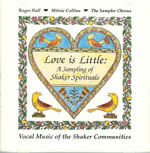
The first few verses are sung by Jeff Harp on the Sampler CD,
Love is Little: A Sampling of Shaker Spirituals.

"Lord of the Dance"
and
"Simple Gifts"
"Lord of the Dance"
Words to the Chorus:
Dance, then, wherever you may be,
I am the Lord of the Dance, said he,
And I'll lead you all, where ever you may be,
And I'll lead you all in the Dance, said he.This is a very popular religious folk song and deservedly so.
Unfortunately, it has been often incorrectly identified, like on Wikipedia.
This is partly because of the show, Lord of the Dance, starring Michael Flatley - the dancer one newspaper reporter called: "Lord of the Pants." Now there is even a 3-D movie about this music and dance spectacle.
In interviews, Flatley first claimed that "Lord of the Dance" was a Celtic folk song and then said it was a Shaker song. Neither claim is correct.
"Lord of the Dance" is a song written by English songwriter and poet, Sydney Carter. He was born on May 6, 1915 - the same day as Elder Joseph Brackett, who wrote the Shaker song, "Simple Gifts." What a coincidence! When I wrote to Sydney Carter, he was very surprised to learn that fact, but also was very pleased.
Carter wrote "Lord of the Dance" in 1963, with 5 verses of original words, and based his tune on "Simple Gifts." There is no other connection to the Shaker dance song.
Sydney Carter wrote "Lord of the Dance" and he should be credited for that.
It is with great sadness to report that Sydney Carter died on March 13, 2004.
For information about him and the authentic words to "Lord of the Dance,"
go to his music publisher's site at:
"Simple Gifts"
Complete words for this song:
'Tis the gift to be simple, 'tis the gift to be free,
'Tis the gift to come down where we ought to be,
And when we find ourselves in the place just right,
'Twill be in the valley of love and delight.
When true simplicity is gain'd
To bow and to bend we shan't be asham'd,
To turn, turn will be out delight
'Till by turning, turning we come round right.
There is so much confusion about this popular Shaker song, that it's time - as the song says - "we come round right."
Notice that the opening lines are NOT -- "Tis a gift to be simple, tis a gift to be free."
Somehow these lines have been changed by folk singers and others over the years.
The original song uses these opening words: "Tis the gift to be simple, tis the gift to be free." To the Shakers, that's a big difference! They are talking about the gift from God, not just any gift.
"Simple Gifts" is usually identified either as a "Traditional Shaker Hymn" or as a "Work Song."
Actually, it's neither a hymn nor a work song.
Shaker hymns mostly have two or more stanzas of text.
This song has only one stanza. If you look closely at the words, you'll notice such lines as: "To turn, turn will be our delight" and "'Till by turning, turning we come round right."
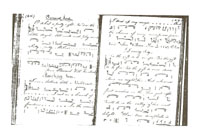
These are dance instructions. Several Shaker manuscripts identify this tune as a "Dancing Song" or "Quick Dance."
The classification of "Simple Gifts" as a work song might be because Shaker dances were also called laboring songs. But that doesn't mean that they sang this song while working in the fields or ironing clothes. To the Shakers, "laboring" was a religious exercise to cleanse them of worldly thoughts and desires as well as for spiritual enrichment.
Many authors have failed to identify Elder Joseph Brackett as the composer of "Simple Gifts" and give the wrong date.
But the Shakers have long believed that Elder Joseph wrote the song.
Some non-Shaker authors and musicians have claimed he wrote the song in 1875. That date is incorrect.
Elder Joseph's dance song was written in 1848 at the Shaker community in Alfred, Maine.
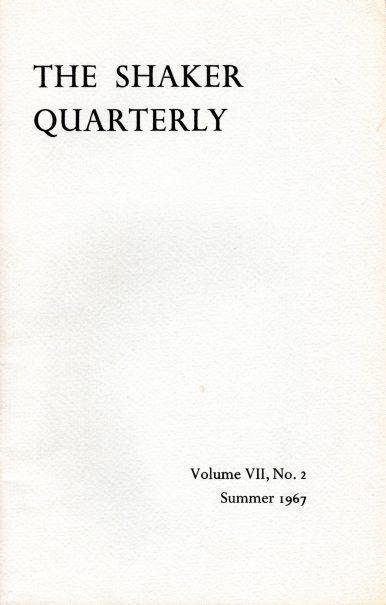
In an article in THE SHAKER QUARTERLY by Sister Mildred Barker in 1967, she provides biographical information about Elder Joseph Brackett as the composer of this dance song. She had lived her youth at the Shaker community in Alfred, Maine and learned that Elder Joseph's song had been written there.
There is also evidence in Shaker manuscripts that he wrote "Simple Gifts"
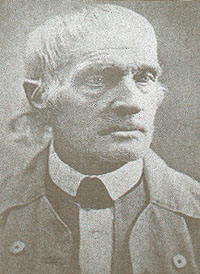
Elder Joseph Brackett Jr. was born on May 6, 1797 in Cumberland, Maine. He died on July 4, 1882 at New Gloucester, Maine.
His portrait still hangs today along with other Shaker leaders at the last remaining Shaker community in Sabbathday Lake, Maine.
-- Roger Lee Hall
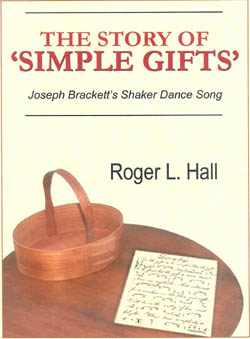
Read more about Elder Joseph Brackett and his Shaker dance song in these two books:
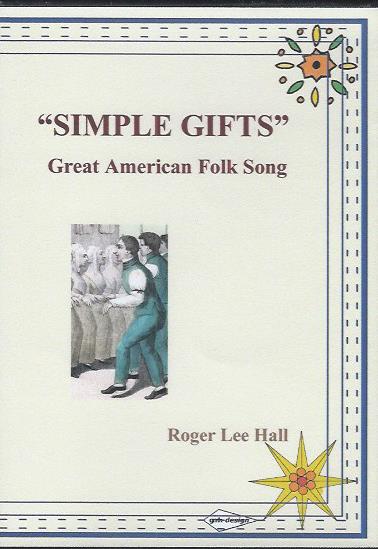
"SIMPLE GIFTS" -
Great American Folk Song
(PineTree Press
"Run,Shaker Life"
and
"Come Life, Shaker Life
To read about these two tunes
"The Spiritual Sailor"
and
"Voyage to Canaan"
"The Spiritual Sailor"
Here is the first of six verses of the hymn:
The people called Christians,
Have many things to tell,
About a land of Canaan,
Where saints and angels dwell;
But here a dismal ocean,
Enclosing them around,
With its tides, still divides
Them from Canaan's happy ground.
On the Boston Camerata CD, Simple Gifts: Shaker Chants and Spirituals,
Joel Cohen wrote this about Track 31:One of the few Shaker songs to have 'crossed over' into the larger American folk-hymn tradition, "The Spiritual Sailor" was included in reprints of The Sacred Harp until the most recent 1991 edition of that songbook.
That is not accurate.
While it's true that "The Spiritual Sailor" was found in The Sacred Harp (and also an earlier tunebook, The Southern Harmony of 1835), the hymn is credited there to "I. Neighbours" (who was not a Shaker) and the source indicated as the " Dover Selection."
Yet, there was a Shaker hymn with a similar text and tune to "The Spiritual Sailor."
It was titled...
"Voyage to Canaan"
This Shaker hymn was written about 1810 by Elder Richard McNemar (1770-1839). The text was included in the first Shaker hymnal, Millennial Praises (1812-1813).
Here is the first verse of this hymn:
A people called Christians,
How many things they tell,
About a land of Canaan,
Where saints and angels dwell;
But sin, that dreadful Ocean
Encloses them around,
With its tides, still divides
Them from Canaan's happy ground.This is the Shaker hymn that Joel Cohen refers to and he received his information from Daniel Patterson's book, The Shaker Spiritual.
It is true the text and the tune are similar to the Sacred Harp version. But the Shaker hymn tune was never harmonized into three or four voice parts. Only the melody was sung by the Shakers.
So did the Shaker hymn really "cross over" into another religious singing tradition?
Most likely not. There are a few examples of other Shaker hymn texts or tunes making their way into other collections, such as in The American Vocalist and The Christian Songster. But they are all credited as Shaker tunes.
What is more likely is the tune and the text came from an earlier hymn, possibly written by I. Neighbours.
Elder Richard McNemar came out of that Great Revival as a New Light preacher in Ohio, so he may have based his text and tune on an earlier hymn. That's why both the Sacred Harp and Shakers versions are similar. They may have originated from the same hymn source. For example, a Shaker manuscript states that McNemar based another hymn, "The Seasons," on a British folk tune, "The Black Joke," which is an unlikely choice with its bawdy original text.
McNemar's hymn was reconstructed in the Shaker music series (No. 51) published in the Shaker Messenger magazine.
In any case, there is no evidence to prove that "The Spiritual Sailor" is a Shaker hymn.
The Shaker hymn text and melody is titled "Voyage to Canaan" and was written by Elder Richard McNemar.
-- Roger Lee Hall
An arrangement of McNeamr's marvelous Shaker hymn is found in the Music Supplement of A Guide to Shaker Music
"Welcome, welcome every guest"
and
"Ode to Contentment"
"Ode to Contentment"
First of the nine verses of the hymn:
Come contentment lovely guest!
Reign unrival'd in my breast;
Thou alone wilt do.
Thou alone canst fill the soul
Ev'ry passion canst control,
When the storm billows roll,
Thou canst bear me through.
It has been claimed by Prof. Carol Medlicott that Issachar Bates wrote both the words and music for "Ode to Contentment" and also based the tune on the canon titled, "Welcome, welcome every guest."
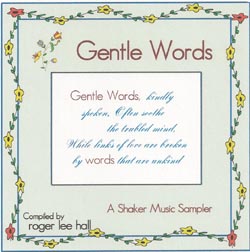
Let's look at both of these claims."Ode to Contentment" is one of the earliest Shaker hymns in three part harmony (Soprano-Tenor-Bass). I first came across this hymn in the early 1970s and have written several scholarly papers on Issachar Bates and was the first one to get this hymn recorded in 1976 -- now available on the CD, Gentle Words - A Shaker Music Sampler.
There still remains some confusion about the author of this Shaker hymn.
In one manuscript "Ode to Contentment" is credited to Issachar Bates for the tune and Richard W. Pelham for the words at North Union, Ohio. The date is given as 1835. Yet, there is also a three part setting (Soprano-Tenor-Bass) of the hymn in a Kentucky Shaker manuscript which reads: "Received June 20, 1833...Copied Oct. 1833." Another manuscript has this hymn credited to "E.W." So there is uncertainty as to who wrote what part of this Shaker hymn.
What is the reason for the difference in attribution? There are several possibilities.
One is that both the words and music were written in 1833 by Issachar Bates, who was the most important early Shaker tunesmith. He could have written the entire hymn himself. But the 1833 manuscript does not identify Issachar Bates.
Though it is difficult to prove the exact year when the words and music of this hymn were composed, the Shakers believed the words originated at North Union, Ohio and not in Kentucky and identified it that way in their 1847 printed hymnal, A Collection of Millennial Hymns.
In addition, "Ode to Contentment" is included in Richard Pelham's own manuscript music book with his hymns and is attributed to him in several manuscripts. Also, he is the one mentioned for the hymn text titled, "Contentment," in The Shaker Manifesto journal, June, 1880, page 123. If he didn't write the hymn text why would the Shakers continue to give him credit for it? It seems that the Shakers believed Richard Pelham was the author of the words to this hymn.Naturally, some of the Shaker manuscripts could be incorrect.
Yet, unless some conclusive evidence comes along to prove otherwise, Richard Pelham should be credited for the hymn text.
Prof. Medlicott claims that Issachar Bates and Richard Pelham could not have "collaborated" and did not ever communicate. The Shakers didn't usually work as a songwriting team. How can a biographer from our time say they never met? In fact they did meet briefly in Ohio. She is basing her assumption on the 1833 manuscript from Kentucky and discounting the 1835 date as a mistake when it appears more often in the manuscripts.
I'll go along with the Shakers who attributed this Shaker hymn to Issachar Bates for the music and Richard Pelham for the words, with the date of 1835 and it originated at North Union, Ohio not South Union, Kentucky.
A copy of a manuscript with that identification is included in my book,
A Guide to Shaker Music"Ode to Contentment" is a very powerful hymn and it is included on these two CDs:
Gentle Words - A Shaker Music Sampler
-- performed by Plymouth Church Choir (First Recording)
Love is Little - A Sampling of Shaker Spirituals --
performed by The Sampler ChorusRead the book review for -- Issachar Bates: A Shaker's Journey
Canon: "Welcome, welcome every guest"
From The Southern Harmony, and Musical Companion (1835)
Welcome, welcome, ev'ry guest,
Welcome to our music feast:
Music is our only cheer,
Fill both soul and ravish'd ear;
Sacred Nine, teach us the mood,
Sweetest notes to be explored.
Softly swell the trembling air,
To complete our concert fair.
Comparing "Ode to Contentment" to the canon, "Welcome, welcome every guest" is even more problematic.
It is true that Issachar Bates (1758-1837) was aware of the New England singing tradition. As I wrote in my monograph, "Come Life, Shaker Life" - The Life and Music of Elder Issachar Bates, he was born in Hingham, Massachusetts and was a Baptist song leader for a few years. He claimed to "sing nearly every song that was going, whether civil, military, sacred or profane."
One of the anthems he remembered was Jacob French's "Farewell Anthem," which Bates quoted in a letter to Shakers at Pleasant Hill, Kentucky before he returned to New Lebanon, New York in 1835. That is documented in his writings. Yet in her book, Issachar Bates: A Shaker's Journey, Carol Medlicott fails to even mention the anthem by French that Bates quotes.
It is possible he knew the Welcome canon and used it as a basis for his own hymn tune. But I doubt it since no mention is made of that connection in his writings.
Why do so many people, including scholars, fail into the "sounds like, so it must be the same" trap? Like so many folk melodies, this is just a simple coincidence that they sound similar. Though there are some similarities in both tune structures, they are not exactly the same. There are similar melodic structures in many folk melodies (both sacred and secular).
So unless some evidence turns up in Shaker documents that Bates based his tune on that canon, I don't go along with that assumption.
--Roger Lee Hall
Original Shaker Music on CDs
These four CD releases are the most extensive ones featuring the Shakers singing and speaking about their own music...
Blended Together
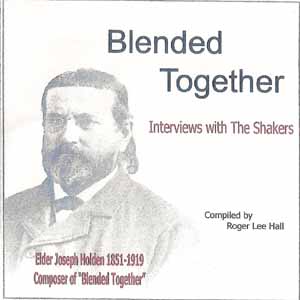
This CD contains in-person interviews with several Shaker sisters about their music and also some of their singing. To order, click on this link:
Blended Together: Interviews with The Shakers
Early Shaker Spirituals
A CD collection of 40 Shaker spirituals sung by The United Society of Shakers, Sabbathday Lake, Maine. Many of the spirituals are sung by Sister R. Mildred Barker, the foremost Shaker singer of her time. The spirituals include laboring songs, gift songs, prayer songs, a hymn and anthem and several interviews with Sister Mildred Barker. Extensive notes and texts for all the music are provided by Daniel W. Patterson.
You can order from Amazon.com here:
Gentle Words - A Shaker Music Sampler
Includes singing from these Shakers: Eldress Bertha Lindsay,
Sister R. Mildred Barker,
Brother Ricardo Belden.
Read more at
Shaker CD and DVD Releases
This companion book is also available separately:
.jpg)
Let Zion Move: Music of the Shakers
This 2 CD set includes 40 Shaker spirituals sung by the Shakers from Canterbury, New Hampshire and Sabbathday Lake, Maine. It includes a history of Shaker music narrated by Sister R. Mildred Barker and Sister Lillian Phelps. There are also interviews with Sister R. Mildred Barker, Eldress Bertha Lindsay, and Sister Lillian Phelps.
The interviews were done in 1960 by William Randle, and in 1972 and 1980 by Roger Hall, who has compiled and written the notes for this unique historical collection.
The set also has an attractive 72 page illustrated booklet with examples of Shaker music and the words to all 40 Shaker spirituals plus a bibliography and discography.
© 2015/Updated; 2025 PineTree Productions. All Rights Reserved for original material on this website.
Contact: pinetreepro@aol.com