Shaker Hymns
About 1805, the first Shaker hymns were written down mostly with text only without any tunes.
The first printed Shaker hymnbook, Millennial Praises,was printed at Hancock, Massachusetts in 1812-1813 and had 140 hymn texts but no tunes. Later on there were tunes written down for the hymns in Shaker music manuscript volumes.
These are two of the prominent hymns in Millennial Praises:
"Mother" -- the best known early Shaker ballad hymn by Richard McNemar which tells the story of early Shakerism and Mother Ann Lee's journey from England to America.
"Rights of Conscience" -- a ballad hymn by Issachar Bates which includes tributes to George Washington and Mother Ann Lee.
The Shakers began composing in more than one voice part in the 1830s. One of the earliest was is the hymn for Soprano-Tenor-Bass, "Ode to Contentment," written between 1833 and 1835, with words by Richard Pelham and music by Issachar Bates. This three-part hymn has been recorded on the Love is Little CD from Sampler Records and also included in the accompanying songbook, compiled and edited by Roger Hall --

The Shakers began using four part harmony, though not extensively, during the 1840s.
By the 1850s, thousands of hymns and songs had been written, most of them single line melodies.
The best-known Shaker song is "Simple Gifts" composed in 1848 by Elder Joseph Brackett Jr.
For information about this song -- click here
The Shakers changed to using four-part harmony in the 1870s in their perioidcal which had various titles between 1871 and 1899: The Shaker (1871-1872), Shaker and Shakeress (1873-1875), The Shaker (1876-1877), The Shaker Manifesto (1878-1882), The Manifesto (1883-1899).
They also included four-part harmony for the first time in their 1875 published hymnal,
Shaker Music: Inspirational Hymns and Melodies Illustrative of the Resurrection Life and Testimony.

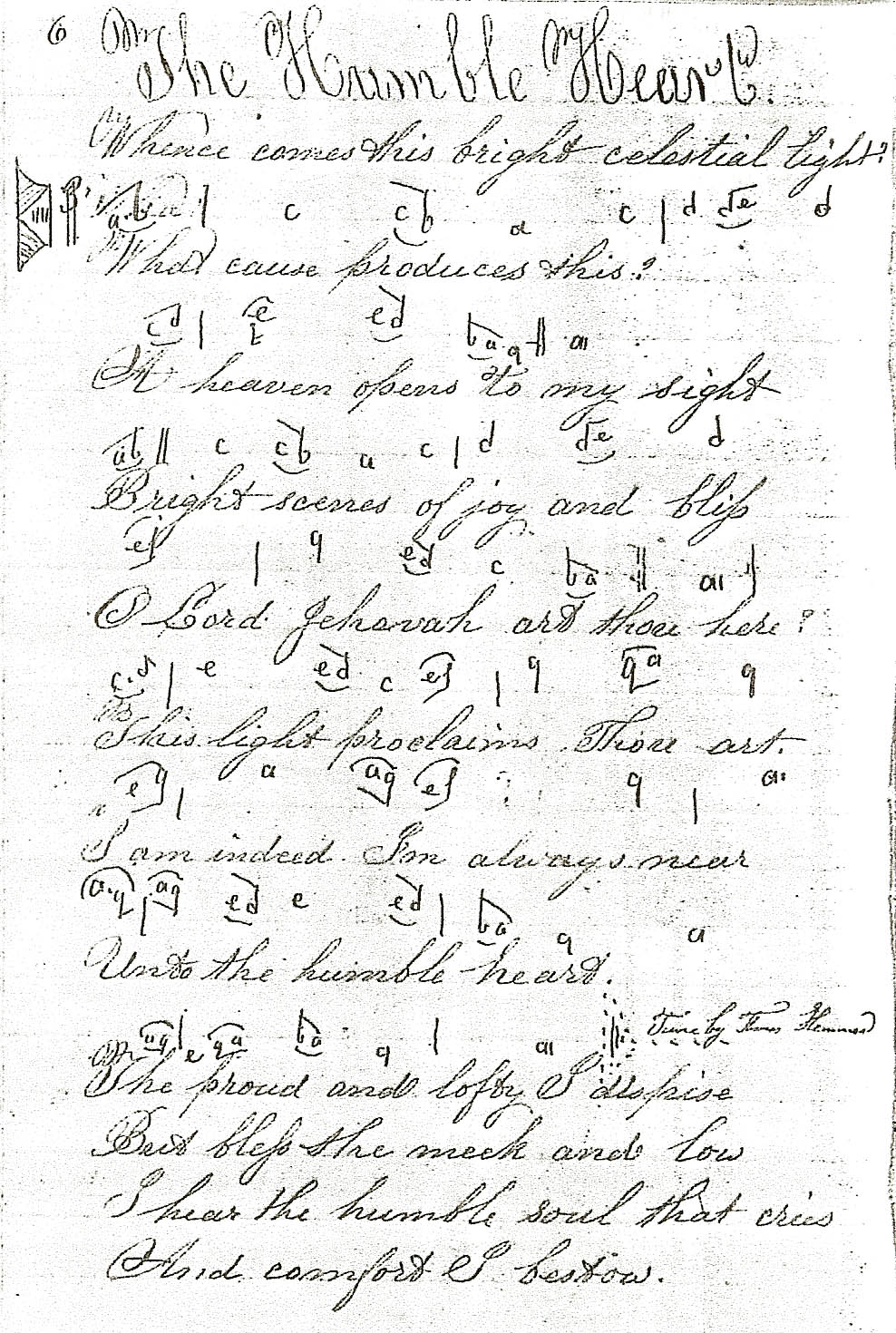
One of the most beautiful early Shaker hymns is titled, "The Humble Heart," words by Eunice Wyeth (1756-1830) and tune by Thomas Hammond Jr. (1791-1880).
Here is the first verse:
Whence come this bright celestial light,
What cause produces this?
A heaven opens to my sight
Birght scenes of joy and bliss.
O Lord Jehovah art thou here?
This light proclaims thou art,
"I am indeed, I'm always near,
Unto the humble heart."
This hymn is a good example of the sharing of creative work by Shaker members, with the words by a Shaker Sister and the tune by a Shaker Brother.
"The Humble Heart" was written at the Shaker community in Harvard, Massachusetts about 1820. Harvard was the place where Mother Ann Lee resided in the early 1780s and the community was very active in music, especially during the early years.
This hymn was the first one in a series of 56 Shaker melodies in the magazine,
The Shaker Messenger.
The titles are listed in the Shaker Music Preservation Series.
"The Humble Heart" has been recorded in an arrangement by Roger Hall,
who sings it in a duet with soprano, Colleen Liggett, on this CD:
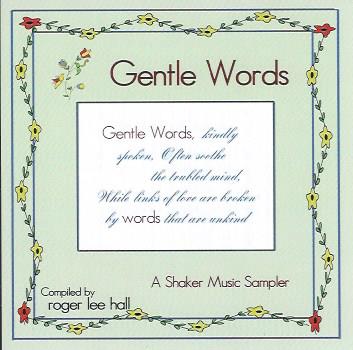
Gentle Words:
A Shaker Music Sampler
Era of Mother's Work
The middle of the 19th century (rougly from 1830s to 1850s) is known as the Era of Mother's work, named in honor of their spiritual head, Mother Ann Lee (1758-1784).
There were numerous songs, hymns and anthems
reportedly "received from the spirit world" mainly from those departed Shakers but also from important historical names like George Washington.
One of these songs in unknown tongues from the 1830s is titled
"Woben mesa crelana"
Here are the words both in "unknown tongue" and in English translation:
Unknown tongue:
A section:
Woben mesa crelana plorada sele
Meclana predale plorada sele
B section:
Meclana predale
ploranda sele
Meclana predale plorrada sele
English translation:
O Mother, O Mother how blessed thou art
I love thee sincerely, sincere from my heart.
Thy gospel is blessed, Yea precious and pure
I love it I'll keep it 'twill for everr endure.
Manuscript citation:
"This song was given and sung in a gift in the Chh's meeting
at Enfield, N.H. the sabbath William Clark was there, March 25th 1838."
SOURCE: The Happy Journey: Thirty-five Shaker Spirituals Compiled by
Miss Clara Endicott Sears. Edited by Roger L. Hall
(Fruitlands Museums, Harvard, Massachusetts, 1982), page 37
Later Period (1860s-1890s)
During these decades Shaker music became more standardized with harmonized tunes introduced, first in two or three-part harmony, then from the 1870s onward in four-part harmony found in many non-Shaker churches.
See this music collection

with examples in four part harmony:
"Prayer Universal" - hymn (page 16)
"Millennial Praise" - anthem (pages 17-19)
"On The Landing of Mother Ann in America"
One of most important anniversaries celebrated each year by the Shakers was the arrival of their spiritual leader, Mother Ann Lee, and a few of her followers in America.
Here is an excerpt of that dangerous voyage:
On the 19th of May 1774, a band of nine set sail from Liverpool in the ship Mariah for New York. Besides Ann Lewew there was her husband, Abraham Stanley, her brother, William Lee, James Whittaker, John Hochnell and his son Richard, James Shepherd, Mary Partington and Nancy lee, a niece of Ann Lee. John Hochnell was the only one posessed of means and it was through his generosity that they were enabled to make the voyage and establish themselves in America
-- Shakerism: Its Meaning and Message by Anna White and Leila S. Taylor, Columbus, Ohio: Press of Fred J. Heer, 1904, page 28
After a long and dangerous voyage, the Shaker group landed in New York
on August 6, 1774. This is a very important date because it signifies the beginning of the Shaker Church in America. This landing was often celebrated with special songs and hymns.
One of these hymns was titled
"On the Landing of Mother Ann in America"
This is the first verse:
O hail this happy welcome day,
When blessed Mother Ann
First landed in America
With her devoted band.
How did the wilderness resound
With Angel's songs of praise
When they on fair Columbia's ground
The gospel standard raised.
Chorus:
Again let the forest loudly resound,
Dear Children of Mother;
Her beautiful way our Spirits have found,
Surpassing all others.
This hymn was written at North Union (today Shaker Heights, Ohio) just before the outbreak of the Civil War in 1860. The Shaker composer of this hymn is unknown.
It was discovered and edited by Roger Hall and sung by a community chorus during the Bicentennial Conference of the Shakers Arrival in America at The Western Reserve Historical Society in Cleveland, Ohio in October of 1974. The hymn was sung the following month when the Sabbathday Lake Shakers were in nearby Shaker Heights for a school teacher's workshop after, thanks to Roger Hall, they met distinquished composer,
Aaron Copland shown here --

Sister Mildred Barker meets Aaron Copland
November 9, 1974
© photo by Gail M. Hall
Hymns
by Shaker women composers
It is not generally known that more of the music from after the Civil War was composed by Shaker women.
Here are some songs by women as printed in the 1893 Shaker hymnal -- most of them have been recorded:
GIVE GOOD GIFTS - Martha Jane Anderson
IF OUR HOME IS SO BEAUTIFUL (slow march) - Elizabette Sutton
IN MY FATHER'S HOUSE (march song) - Eliza Rayson
IN WISDOM'S LOVELY PLEASANT WAYS - Anna White
LOOK UP THROUGH THE CLOUDS (march song) - Mary Ann Gillespie
PEACE AND JOY - Grace
Bowers
PRECIOUS GOSPEL KINDRED - Mary Ann Gillespie
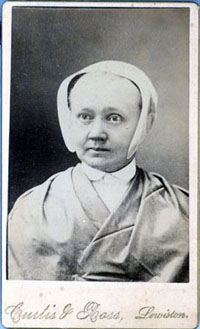
Eldress Mary Ann Gillespie (1829-1887)
There were over 1,500 Shaker songs, hymns and anthems included in their printed hymnals from 1852 to 1908.

One of the favorite later Shaker hymns was "Prayer Universal" by
Eldress Dorothy A. Durgin (1825-1898) at Canterbury, New Hampshire.
The actual date when it was composed is not certain
but it was probably in the 1890s. The hymn was included in the last printed Shaker hymnal, published at Canterbury in 1908.
Here is the first verse:
The Spirit is calling, earnestly calling,
O Zion unfold in deep prayer,
O pray for the fathers, the sisters and brothers,
O payer for the whole household,
O pray for the mothers, remember all others;
O pray for the whole, whole world.
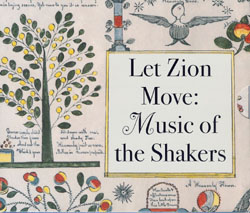
As mentioned by Sister Lillian Phelps on the "Let Zion Move" 2CD collection,
edited by Roger Hall from the original 10 LP album, "The Shaker Heritage,"
this Shaker hymn takes in "the whole world."
It was recorded by the Canterbury Singers,
directed by Kathryn Southworth.
To listen to their performance with reed organ accompaniment -- click here
Their performancxe is included on two AMRC CDs:
.jpg)
"Celestial Praises" - A Celebration of Shaker Spirituals"
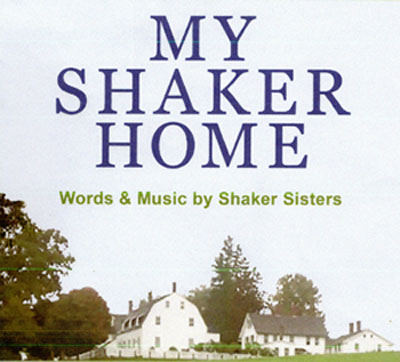
"My Shaker Home" - Words & Music by Shaker Sisters
Shaker anthems
Around 1815, the third type of Shaker music was introduced -- the anthem.
This was a longer piece of unrhymed music, similar to anthems by New England composers like William Billings and Jacob French.
The early Shaker anthems had melody only, and three or four-part harmony was later added, starting in the 1830s and especially after 1870.

One of the most prominent early anthems was "Mount Zion" by Issachar Bates (1758-1837), composed about 1815. The anthem was included in the first published Shaker hymnal with music, A Sacred Repository of Anthems and Hymns, printed in 1852 at Canterbury, New Hampshire by Elder Henry C. Blinn.
"Mount Zion" is performed on the CD,
Gentle Words: A Shaker Music Sampler.

A much later anthem in four voice parts (SATB) was Elder James Russell's 1883 anthem, "Millennial Praise" [also recorded on the Gentle Words CD].
All three types of Shaker music (songs, hymns, and anthems)
continued to be written throughout the 19th century.
Go to Part Three: 20th Century Shaker Music>
<Go back to Part One: 18th Century Shaker Music
Please help the educational misssion of this website.
Purchase music books, music broadsides, CDs or DVDs at the

Store
Return to top of this page